The 60s were a terrible time for style, particularly interior design. As anyone who has had to renovate a home last decorated in the 60s will tell you, people back then had some strange ideas as to what acceptable design choices were; textured wallpaper, super-thick carpets, garish color combinations, and popcorn ceilings are just a few examples of the awesomeness of the era. My in-laws, for example, when they moved into their current home were faced with lime green shag carpeting, large black and white tiles, and white wallpaper with a black paisley pattern in felt. My grandma’s house, also decorated in the 60s, features a bathroom with pink shag carpeting and red wallpaper with a reflective gold pattern. As time marched forward, things unfortunately did not improve. The 70s, with its harvest gold and pea green fads, was hardly an improvement. My mom’s kitchen still has a few harvest gold holdovers. In terms of fashion, things got worse. Extremely loud patterns and skimpy shorts were the norm. Polyester was huge.
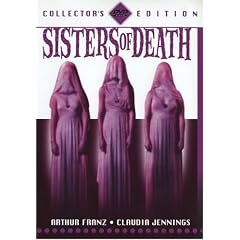
I don’t normally make it a habit to go on and on about the unfortunate stylistic choices of our forbearers, but in this case the diatribe is on point. Sisters of Death, while filmed in the late 70s, was filmed at a ranch house decorated in the style of the late 60s. Unfortunately, this left the film with the unenviable task of using the worst of both worlds: 70s fashion and 60s interior decorating style. The former made itself apparent after the opening segment and credits wrapped up. There are five sisters of death, and rather than attempt to learn their names I found it easier to identify them by their careful conformance to obvious film types. We have a career-oriented ladder climber, a prostitute, a new-age hippie guru, a skanky hitchhiker, and an airhead (and a patriotic one at that - her first outfit featured a halter top and short shorts decked out with the American flag). None of these women ever, ever broke out of type. They even dressed according to type. The ambitious one wore high fashion, the prostitute dressed accordingly, the hippie wore classic white hippie threads and a “power crystal,” the skanky hitchhiker also dressed accordingly, and the airhead didn’t seem to pay much attention to what she wore.
These stylistic choices had, surprisingly, both positive and negative effects on the film. The dark design of the house, combined with its lack of adequate lighting and the poor lighting design by an amateur film crew render the house a genuinely spooky place. See the following clip (spoiler alert: some of the girls die!):
(Please note that the girl in the doorway is incapacitated by a neck chop. I wish I knew how to give an effective paralyzing neck chop.) Maybe I should give the crew the benefit of the doubt; perhaps their lighting design was intentional. Ehhhhh, judging by the rest of the film, I doubt it. On the negative side, such terrible design made me laugh and drew me out of any sort of tension the film tried to produce. This film has not aged well at all.
As for plot, Sisters of Death is as straightforward as any slasher film can be. A girl dies during a sorority initiation ceremony, and seven years later the surviving sorority sisters (of death!) are invited to a reunion. Each naturally assumes that a different girl is coordinating the event, and as such are surprised when they meet up with each other at a fabulous Paso Robles motel and two shady guys approach them (including Joe Tata, who later went on to fame as Joe, owner/operator of the Peach Pit on 90210) with the offer of a ride to their final destination. Naturally, these girls are brilliant, and decide to hop in the car with these two be-turtlenecked gentlemen and are whisked away to an aging mansion in the middle of the California back country. The setting is effective; the house is surrounded by a tall fence, the surrounding countryside is barren except for scrub brush and the occasional tree, and the house lacks any kind of landscaping. On the plus side, it does have a pool!
The girls arrive, and assume that their benefactor has given them free reign of the house. They have some drinks and check out the house, marveling at how wonderful it is (one of the girls remarks that it would be a great place for an orgy) - yet another sign of serious mental illness. The guys were only hired to drop off the girls, but soon after they realize that there are several skanks back at the house with no other guys around. With such high odds of scoring, they decide to hop the fence and join in the party. At this point we are introduced to the girls’ mysterious benefactor who has sequestered himself in the upstairs section of the home. He is upset that the guys have returned and throws a switch, electrifying the fence. The guys are now trapped, although they really don’t mind. After all, skanks!
The rest of the film follows all the usual tropes. Girls are picked off one-by-one and are generally menaced by the skeevy guy upstairs. He turns out to be the father of the dead girl from the initiation at the beginning (shocker!) and one of the girls—the prostitute—is his accomplice (double shocker!). This avenging father is perhaps one of the least menacing villains in slasher film history. He looks like Jed Clampett and wears sport coats and penny loafers. The most disturbing thing about him was the obsession he had over his poor dead daughter. Judging from his explanatory speech to the sole remaining sister of death (other than the accomplice)—the socialite—his relationship with his daughter was creepier than Joe and Jessica Simpsons’. Before Skeevy Dad can execute the socialite with the gatling gun he has mounted in his hunting trophy room, Joe Tata, the surviving turtleneck, busts in the room, incapacitates Skeevy Dad, and kills the prostitute with the gatling gun.* Apparently they forgot that he was not dead; with so many victims, who can keep track of those that are all dead and those that are mostly dead?
The film would not be complete without another twist or two, and sure enough, the writers provided. It turns out (triple shocker!) the socialite was the killer after all! She set up the prostitute, who in turn was manipulating the father. Here is a rundown of the films juiciest bits—the murders—Clue-style:
1. The Hippie (aren’t they always the first to die), on the front ‘lawn’, with her mystic crystal necklace.
2. The Airhead, in the bathroom, with scissors.
3. Non-Tata Turtleneck, by the electric fence, in the yard.
4. Slutty Hitchhiker, in the cellar, by a rattlesnake (yes, a rattlesnake).
5. The Prostitute, in the trophy room, with the gatling gun.
6. Skeevy Dad, in the trophy room, one shot by the Socialite.
Closing thoughts. This film was delightfully bad. There was just enough unintentional comedy to make all the slasher film tropes go down easy. The scariest part for me truly was the house itself. I couldn’t tell at first if it had wallpaper or some kind of cultivated mold growing on the walls. I don’t know what kind of orgies they had back in the 70s, but if they were not only willing but excited to have them in such a house, they must have been seriously desperate for the space with which to orgy.
My Rating: 5 out of 10 Skeevy Dads.
Your next film is Death Bed: the Bed that Eats. Do I really need to set it up any further than that?
*I didn’t take very good notes on this part, so I can’t quite remember how this last scene went down. I’m pretty sure that Joe Tata killed the Prostitute, but she might have been killed by Skeevy Dad beforehand.
