Sunday, November 15, 2009

Death Bed: The Bed That Eats!

Jake, you’ve made me watch some pretty bad movies so far, but with Death Bed: The Bed That Eats, you really went for the jugular. It may take me a while to forgive you for this one. This movie was hard to watch, hard to forget, and for some reason, is really hard for me to describe. I’ve been trying to write this review for months, but can’t seem to figure out how to talk about it. This is the best I can do.


Death Bed: The Bed That Eats isn’t what you would call a scary movie, but it was horribly horribly creepy. Everything about it—the lighting, the sets, the sounds, the colors, the acting—left me feeling disturbed and unclean. I’ve never seen anything like it. I hope that I will never have to see anything like it again.

Any entertainment that I derived from this movie was, I’m sure, purely unintentional on the part of anyone involved in making the movie. And yet, underneath my laughter (and I laughed out loud throughout most of this movie), just hiding below the surface was an almost nauseous sensation—unsettling, disturbing, confusing. The movie was difficult to watch and I can’t quite figure out why. Sleazy is a word that keeps coming to mind, even though it wasn't really graphic in any sexual way. You did warn me that there would be some boobies, and the film delivered on your promise, but I think that you definitely downplayed the sheer magnitude of the breastliness, my friend! I didn’t realize that nearly every single woman in the film would at some point take her top off FOR NO REASON AT ALL! And yet, in a cruel and ironic twist, not a single boobie in this movie was a pleasure to watch. Not a single one!

So, basically the movie is about a bed that eats people. I assumed this much going into the movie, based on the title Death Bed: The Bed That Eats (the title remains vague as to what the bed eats, but I figured the movie wasn’t going to be about a bed that eats casseroles or something). But I guess I imagined a bed that ate people in a more conventional way, you know, with a mouth and teeth and all. Instead, after watching the movie, it would be more accurate to say that the bed digests people. But a movie called Digestion Bed: The Bed That Slowly Passes Things Through Its Tummy just doesn’t have the same ring to it, does it? For an example of how the bed’s eating process goes down, see below:

Step 1: A couple is gettin’ it on atop an old musty bed in an abandoned house while an apple from their lunch waits patiently for them. Suddenly but surreptitiously, a vile, yellow foam slowly rises from the bed and surrounds the apple.

Step 2: The foam covers the apple completely and pulls it down into the bed’s mattress stomach (I can only assume).

Step 3: Inside the stomach, the apple is digested. This looks disgusting, doesn’t it? And this is just fruit. Imagine what a chicken leg or a grandma will look like in there (later we will seem them too).

Step 4: In a spirit of good fun, the bed returns the uneaten portion of the apple to the surface of the bed.

I don’t really know what sort of sounds I would expect to hear from a bed that eats things by engulfing them in a foamy yellow liquid and digesting them, but they certainly wouldn’t be the sounds that the bed makes in this movie. For some reason, even though the bed doesn’t possess anything resembling a set of teeth, when the bed is “eating,” distinct Cookie Monster-esque chomping sounds are heard coupled with (I swear) what sounds like sound effects from the console version of the 1980’s Tron video game.

So why does this bed possess the power and desire to eat things? It’s really quite simple: A demon was living in a tree and decided to change himself into a breeze and seduce a pretty girl. He made a bed to seduce her on, but then she died. This made him sad and so his eyes got cold and then they shattered. His tears of blood fell onto the bed and then the demon flew back into a tree. The bloody tears on the bed made it come to life and be all hungry. Then the bed started eating everyone including an artist who is trapped in a painting on the wall. Also, the demon sleeps once every ten years and that’s when you can kill the bed. It’s the classic demon meets girl, kills girl, spawns a flesh-eating demon bed story.

The demon: Look deep into my unibrow.

Anyway, in order to give us something to watch the bed eat, three women arrive from the city to stay in the tiny window-less, bathroom-less building with no electricity or plumbing that the demon bed lives in. For some reason, it’s considered a pretty awesome place to stay as long as no one ever needs to pee or look out of a window. Fortunately, no one ever does. Each of the women are annoying in their own way which makes it convenient because you don’t really care much when two of them are eaten by the bed. The one who survives is probably the most sad and unmotivated protagonist I’ve ever seen in a movie. I’ll call her The Mope. Most of the movie, she looks like this:


The rest of the movie, she looks like this:


Moping seems to be the way that she deals with life’s challenges such as having your two friends eaten by a large four-poster bed. The Death Bed somehow locks the door so The Mope can’t get away, yet seems hesitant to eat such a morose morsel. Fortunately, The Mope has a brother named Rusty Russ who is completely awesome. He swoops into this movie to save us all from interminable sad sack-ness.

Rusty Russ: Our lazy-eyed hero

Rusty Russ shows up and boy are we glad that he does. As awful as this movie is, Rusty Russ gives us one of the most amazingly awesome scenes in cinema history. Here’s how it goes: If I remember correctly, Rusty Russ tries his hand at killing the bed by stabbing it with a knife. The bed then sucks his knife-wielding hands into its mattress stomach filled with digestive fluids. Aaaiiieee! What could be happening to Rusty’s hands? Rusty Russ struggles with the bed and finally manages to pull his hands free. What happened to your hands, Rusty? Are they okay? Show them to us! The suspense is killing us! At last Rusty brings his hands up for inspection. And ... the bed has digested his flesh! Rusty Russ has skeleton hands!!!

And The Mope looks on.

Rusty Russ and his sister’s reaction is what really makes the scene here. Basically, they have no reaction whatsoever. It’s as if the director was saying, Don’t do anything! Just stare and mope! More staring! More moping! Keep it up! That’s it! Brilliant!

The Mope: “Maybe ceaseless dejection will bring them back, Rusty.”

The staring and moping continue. Then Rusty Russ decides that since his skeleton hands will eventually fall off anyway, his sister should go ahead and painfully break off his skeleton hands. Purely so we can enjoy watching it! And it’s awesome!

Eventually they kill the bed. How? It’s simple: they build a circle of wood outside, then cut a circle of blood [huh?] into the floor around the bed to match. Then they put a piece of Rusty Russ’s old finger together with some of their dead friend’s hair. Then the circle of blood around the bed starts on fire and transports the bed outside to the middle of the circle of wood. Then the original girl who the demon fell in love with wakes from her grave (naked of course) and walks to the bed where she meets up with Rusty Russ and then they do it. Yeah, that's right. I said they do it. And apparently Rusty Russ is the man because it sets the bed ON FIRE, literally. Bed dies. Roll credits.

“If eating people is wrong, then I don’t want to be ri— ... arggh! I’m on fire!!!”

Holy crap, Jake, what were you trying to do to me? I don’t even know how I can rate something like this. For sheer bad movie entertainment value, it’s got to deserve maybe 8 out of 10 Rusty Russ skeleton fingers. This movie will not be soon forgotten, nor will you for unleashing it on me!

P.S. Thank you!

Friday, February 6, 2009

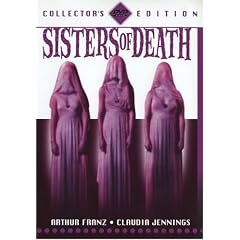
Sisters of Death

Derek, of course we’re still buddies. The question is, however, who is who in that picture from the glorious cover of the Buddies calendar? Am I the delightfully cross-eyed kitten? Are you the dog whose hair has been photoshopped into blurry oblivion? Can we escape from whomever placed us in what is so obviously a picnic basket? I don’t know if I like where this is headed...

The 60s were a terrible time for style, particularly interior design. As anyone who has had to renovate a home last decorated in the 60s will tell you, people back then had some strange ideas as to what acceptable design choices were; textured wallpaper, super-thick carpets, garish color combinations, and popcorn ceilings are just a few examples of the awesomeness of the era. My in-laws, for example, when they moved into their current home were faced with lime green shag carpeting, large black and white tiles, and white wallpaper with a black paisley pattern in felt. My grandma’s house, also decorated in the 60s, features a bathroom with pink shag carpeting and red wallpaper with a reflective gold pattern. As time marched forward, things unfortunately did not improve. The 70s, with its harvest gold and pea green fads, was hardly an improvement. My mom’s kitchen still has a few harvest gold holdovers. In terms of fashion, things got worse. Extremely loud patterns and skimpy shorts were the norm. Polyester was huge.


I don’t normally make it a habit to go on and on about the unfortunate stylistic choices of our forbearers, but in this case the diatribe is on point. Sisters of Death, while filmed in the late 70s, was filmed at a ranch house decorated in the style of the late 60s. Unfortunately, this left the film with the unenviable task of using the worst of both worlds: 70s fashion and 60s interior decorating style. The former made itself apparent after the opening segment and credits wrapped up. There are five sisters of death, and rather than attempt to learn their names I found it easier to identify them by their careful conformance to obvious film types. We have a career-oriented ladder climber, a prostitute, a new-age hippie guru, a skanky hitchhiker, and an airhead (and a patriotic one at that - her first outfit featured a halter top and short shorts decked out with the American flag). None of these women ever, ever broke out of type. They even dressed according to type. The ambitious one wore high fashion, the prostitute dressed accordingly, the hippie wore classic white hippie threads and a “power crystal,” the skanky hitchhiker also dressed accordingly, and the airhead didn’t seem to pay much attention to what she wore.

These stylistic choices had, surprisingly, both positive and negative effects on the film. The dark design of the house, combined with its lack of adequate lighting and the poor lighting design by an amateur film crew render the house a genuinely spooky place. See the following clip (spoiler alert: some of the girls die!):


(Please note that the girl in the doorway is incapacitated by a neck chop. I wish I knew how to give an effective paralyzing neck chop.) Maybe I should give the crew the benefit of the doubt; perhaps their lighting design was intentional. Ehhhhh, judging by the rest of the film, I doubt it. On the negative side, such terrible design made me laugh and drew me out of any sort of tension the film tried to produce. This film has not aged well at all.

As for plot, Sisters of Death is as straightforward as any slasher film can be. A girl dies during a sorority initiation ceremony, and seven years later the surviving sorority sisters (of death!) are invited to a reunion. Each naturally assumes that a different girl is coordinating the event, and as such are surprised when they meet up with each other at a fabulous Paso Robles motel and two shady guys approach them (including Joe Tata, who later went on to fame as Joe, owner/operator of the Peach Pit on 90210) with the offer of a ride to their final destination. Naturally, these girls are brilliant, and decide to hop in the car with these two be-turtlenecked gentlemen and are whisked away to an aging mansion in the middle of the California back country. The setting is effective; the house is surrounded by a tall fence, the surrounding countryside is barren except for scrub brush and the occasional tree, and the house lacks any kind of landscaping. On the plus side, it does have a pool!

The girls arrive, and assume that their benefactor has given them free reign of the house. They have some drinks and check out the house, marveling at how wonderful it is (one of the girls remarks that it would be a great place for an orgy) - yet another sign of serious mental illness. The guys were only hired to drop off the girls, but soon after they realize that there are several skanks back at the house with no other guys around. With such high odds of scoring, they decide to hop the fence and join in the party. At this point we are introduced to the girls’ mysterious benefactor who has sequestered himself in the upstairs section of the home. He is upset that the guys have returned and throws a switch, electrifying the fence. The guys are now trapped, although they really don’t mind. After all, skanks!

The rest of the film follows all the usual tropes. Girls are picked off one-by-one and are generally menaced by the skeevy guy upstairs. He turns out to be the father of the dead girl from the initiation at the beginning (shocker!) and one of the girls—the prostitute—is his accomplice (double shocker!). This avenging father is perhaps one of the least menacing villains in slasher film history. He looks like Jed Clampett and wears sport coats and penny loafers. The most disturbing thing about him was the obsession he had over his poor dead daughter. Judging from his explanatory speech to the sole remaining sister of death (other than the accomplice)—the socialite—his relationship with his daughter was creepier than Joe and Jessica Simpsons’. Before Skeevy Dad can execute the socialite with the gatling gun he has mounted in his hunting trophy room, Joe Tata, the surviving turtleneck, busts in the room, incapacitates Skeevy Dad, and kills the prostitute with the gatling gun.* Apparently they forgot that he was not dead; with so many victims, who can keep track of those that are all dead and those that are mostly dead?

The film would not be complete without another twist or two, and sure enough, the writers provided. It turns out (triple shocker!) the socialite was the killer after all! She set up the prostitute, who in turn was manipulating the father. Here is a rundown of the films juiciest bits—the murders—Clue-style:
1. The Hippie (aren’t they always the first to die), on the front ‘lawn’, with her mystic crystal necklace.
2. The Airhead, in the bathroom, with scissors.
3. Non-Tata Turtleneck, by the electric fence, in the yard.
4. Slutty Hitchhiker, in the cellar, by a rattlesnake (yes, a rattlesnake).
5. The Prostitute, in the trophy room, with the gatling gun.
6. Skeevy Dad, in the trophy room, one shot by the Socialite.

Closing thoughts. This film was delightfully bad. There was just enough unintentional comedy to make all the slasher film tropes go down easy. The scariest part for me truly was the house itself. I couldn’t tell at first if it had wallpaper or some kind of cultivated mold growing on the walls. I don’t know what kind of orgies they had back in the 70s, but if they were not only willing but excited to have them in such a house, they must have been seriously desperate for the space with which to orgy.

My Rating: 5 out of 10 Skeevy Dads.

Your next film is Death Bed: the Bed that Eats. Do I really need to set it up any further than that?

*I didn’t take very good notes on this part, so I can’t quite remember how this last scene went down. I’m pretty sure that Joe Tata killed the Prostitute, but she might have been killed by Skeevy Dad beforehand.

Wednesday, December 3, 2008

Thrashin’

Hi Jake. This review has been 90% finished and sitting on my iPod for about 4 months now. I’m finally going to finish it and post it. I hope we’re still buddies.


Here goes:

I’m not going to make you read through my entire review before telling you what I really thought of this movie: Thrashin’ was awesome. I really mean that. It’s not often that a person can partake of such a delicious casserole of unintentional hilarity, blatant product placement, awkward sex and incredible hair.

Let me say, though, that Thrashin’ really makes me feel old. I was 11 years old when this came out. Watching this movie, it’s hard to believe that 1986 looks so dated, almost like it was the 70’s or something. But the styles are uncomfortably familiar to me. When I was 11 years old, I wanted to dress like half of these guys. I had the hots for girls that looked like girls in this movie. This was definitely the mid 80’s. I just can’t believe that it really looked like that. But I know that it did. I was there. Yes, I am old, and someday I will die.

Thrashin’ is often described as Romeo and Juliet on skateboards which is a pretty good description, I suppose. I’d probably rather describe Romeo and Juliet as Thrashin’ without skateboards, but that’s just a matter of preference. It’s the timeless story of a boy and a girl who should be enemies but instead fall in love against all odds. And then they both take poison and die. Or in this case, instead of the poison-taking, the boy enters a high-speed downhill skateboard race and totally wins it. And then neither of them die.

Let me sum up the movie before getting to how awesome it is. Josh Brolin is Romeo, or in this case, Corey.

Brolin in the defining role of his career.

He skateboards with the local ramp skateboarders, known conveniently enough as the Ramp Locals. They are a rowdy, yet lovable bunch of street youths who display just enough rebellion for us to be comfortable with. Bless their hearts.

The Ramp Locals enjoy Pepsi while rebelling in a good-natured way. Those guys!

On the other side of things are the Daggers, who are completely too rebellious for us to be comfortable with. They wear a lot of denim and when they skateboard upon the street, they take up the entire street, weaving back and forth in menacing fashion.

The Daggers get all up in our faces with their rebellion. Hey! Cut it out you jerks!

The Daggers are led by Tommy Hook who, tragically, does NOT have a hook for a hand, but is still a rather bad ass.

Tommy Hook: surprisingly not hook-handed.

The two skateboard gangs meet every so often for menace and feuding. Suddenly, Tommy Hook’s sister, Chrissy, appears and she and Brolin fall in love.

Chrissy: probably the one person in the movie who looks like she couldn’t possibly be related to Tommy Hook (her brother).

Time passes. Eventually, Brolin wins a downhill skateboarding race. That’s the end of the movie.

So let’s get to showing how awesome this movie is.

Here are my top 5 reasons that Thrashin’ rules:

#5: Breakin’ Gets the Smack-down

In an early scene, Tommy Hook ends the practice of breakdancing. I mean really, that was so two years ago (the movie Breakin’ came out two years before Thrashin’).

Tommy watches a total dipwad do a head spin.

Tommy Hook: “Breakin’ is a memory.” “For wimps,” adds the fellow with green hair.

The result: no one ever breakdanced again.


#4: Sam Flood, Inventor of Skateboarding


Wikipedia claims that no one knows who built the first skateboard, but Wikipedia obviously hasn’t watched Thrashin’. According to the movie, rumor has it that Sam Flood invented skateboarding. That’s right, this chubby, pitiful man with Donald Trump hair invented skateboarding. He’s pretty much exactly how I pictured the inventor of skateboarding would look.

Sam Flood: teenage subculture mastermind.


#3: Tommy Hook: Badass?


Tommy Hook, as leader of the Daggers, is by all accounts, a badass. But take a closer look at Tommy and you may find some surprising cracks in the facade.

Exhibit A: Tommy drinks store-brand generic beer. I don’t drink, but no-name beer doesn’t seem very badass to me.

Exhibit B: Tommy Hook eats Life cereal in public. Again, this does not seem in harmony with the badass lifestyle.

Exhibit C: Tommy Hook plays air guitar for his friends. This is literally a scene where all of Tommy’s friends are watching him rock out on an imaginary guitar to the amusement and delight of all. At this point, I feel a deep sense of sorrow for Tommy Hook and am sorry that I even brought this whole thing up.


#2: First Recorded Instance of the “Surprise Birdie”

You and your friends may have thought that you were pretty clever and invented the surprise birdie yourselves, but unfortunately you’re wrong. The surprise birdie was invented by Corey Webster just prior to the “L.A. Massacre,” a hellish downhill race that is the movie’s climactic event. Let me break it down for you.

Tommy Hook sees Corey Webster and then grinds his fist into his hand in a menacing way, like so:


Then Corey Webster returns the gesture, raising his fist into the air. What is he saying? Good luck? Live strong? May the best man win?

and then...


Whaaa?? Oh no! That’s not what he meant at all! Tommy Hook, my friend, you just got THE SURPRISE BIRD!!!


#1: The Awkward Sex Scene

I have never in my life witnessed a love scene as awkward as the one in Thrashin’. I’m embarrassed just thinking about it. I just want to run and hide from it. But I can’t. Here’s how it unfolds:

In some sort of mobile home, Brolin shows off his logo idea for a skateboard company to Chrissy.

Okay, so his logo is seriously a giant spider holding what appears to be an elderly woman with sagging boobs in a flimsy swimsuit. “That’s what sells skateboards,” Brolin says. Sensing opportunity, Chrissy makes her move.

“You’d like to be held like that?” she asks.

“Yeah,” Brolin says, meaning that he would literally like to be held like a giant spider holds an elderly woman with sagging boobs.

“You’d like to be grabbed like that?” asks Chrissy, imagining herself as a giant spider. “Yeah,” replies Brolin, imagining himself as an elderly woman.

The rest of the love scene looks as awkward as the above image and it goes on for what seems like about 10 minutes. You’ve seen it. You know what I’m talking about.

And that’s why Thrashin’ is so awesome. Thanks for introducing me to this movie. I give it 8 out of 10 Tommy Hook air guitar solos. So now you can finally write your Sisters of Death review and challenge me again. I decree that I will not spend this much time on another movie review.

Monday, July 14, 2008

Night of the Lepus

Jake, when you first challenged me to watch Night of the Lepus, you mentioned three things: Janet Leigh, DeForest Kelly, and giant mutant rabbits. At the time, I was pretty sure that this combination would equal the perfect movie, but now I see that this was only nearly the perfect movie. (The perfect movie, in case you’re wondering is actually a giant Janet Leigh, a mutant DeForest Kelly and then just plain old regular rabbits).

First off, I think the good folks who had the thankless task of marketing Night of the Lepus in 1972 deserve some love here. The film’s movie poster brilliantly leaves EVERYTHING to the imagination:


Looking at the poster now, it looks like this is could be one seriously scary movie. I mean, look at that swarm of eyes peering out of that dark cave! There could be anything lurking in there! And nothing to fight with but ... a shovel! What is this “scuttling, shambling horde ... destroying all in their path?” (Never mind that Marilyn Monroe has somehow shown up to the fight wearing her dress from The Seven Year Itch!) And without the aid of a Latin dictionary, one would assume that a Lepus is something pretty horrifying.

I can only imagine the looks on the faces of America when they entered the movie theaters with their popcorn and soda, waited for the lights to dim, and then saw this:


And the truth came out. Night of the Lepus is a horror movie about rabbits.

The premise is simple: rabbits are causing trouble for the ranchers because they’re overrunning the land, and digging holes that cause the ranchers’ horses to step in them and break their legs. There are too many rabbits for the ranchers to handle, so they call in the scientists. The scientists don’t want to poison the bunnies (that would be cruel), so they develop an experimental DNA-altering serum. As with all good science, they treat one group of rabbits with the serum and also keep an untreated control group to compare the results. Everything should be fine, right? AS LONG AS SOMEONE DOESN’T SWITCH THE RABBITS! More about that in a second.

Janet Leigh and some other guy are the scientists. DeForest Kelly (Bones from Star Trek) is president of a college and gives the scientists the job, but mostly he’s just in the movie to be awesome. I was disappointed to see that Janet Leigh wasn’t quite as hot as she was in her Hitchcock days, but still, not too bad for an older lady. Hubba hubba:


DeForest Kelly, as always, was 110% man (as you can see above), and sported a mustache which sort of made him look like Charles Bronson as a creepy school janitor. I kept wishing that he would take Janet into his arms and show her how they do things on the Enterprise, if you know what I mean (’cause I’m not really sure if I do).

The other guy I didn’t care much about, but he played Janet Leigh’s scientist husband. I must say, I didn’t trust him. He seemed just a bit too slick to me. Check out that hair. That’s the haircut of a guy who definitely cheats on his wife. Janet Leigh, you deserve better.


Unfortunately for them and for all of humanity, Janet Leigh and Mr. Slick also have a little daughter and she causes lots of problems. Why is there always a child?! Curse the child! In this case, the scientists’ little daughter switches one of the serum-treated rabbits with the control rabbits for NO REASON WHATSOEVER while her parents aren’t looking. Of course this sets into motion a chain of events that result in the grisly deaths of hundreds of people, with dismemberment and bloody gore all around. The DNA-altered rabbit is released into the wild (again by the little girl) and starts doing its bunny biz-ness with other bunnies, resulting in hundreds of new mutant bunnies. Soon the once quiet desert nights are filled with the sounds of giant, bounding bunny feet, rumbling across the plains. The enormous rabbits predictably have a taste for human flesh and begin indiscriminately attacking innocent people with bloody (and hilarious) results.

You may ask yourself, later in the movie, does The Child ever think back to what she did and think, ‘Golly, I've more or less just killed all of these people myself through my baffling and inexplicable actions?’ No. There’s no responsibility taken and no remorse. If this is what kids were like in the 70’s, it’s no wonder today’s generation is so messed up.

Half of the movie, I was just hoping that The Child would get it. I mean, she caused all of the trouble. The blood was on her hands. Or at least, the blood was on the giant bunny hands that she created by switching the rabbits for NO REASON WHATSOEVER. Throughout the movie, I kept hoping that this time, the bunnies were coming for her. They would back her into a corner and look at her with their dark, silent eyes that say, “Look what you’ve turned us into! Once we were lovable! Now we’re monsters!” and then they’d finish her right there. But you can’t kill a little kid in a movie (or a dog) and besides, if they had actually killed her, I might have felt really bad for wishing for it the whole time.

So most of the movie is a serious of hilarious, yet mildly disturbing scenes of bunny-on-human violence, each ending with bared teeth, a bunny growl, a human scream and then blood and limbs strewn. Honestly, those close-up shots of the bunnies’ teeth are sort of creepy:


I imagine that the producers of the movie had this one still shot with them throughout the production and whenever anyone would say, “Hmmm, are you sure that large bunnies will be scary enough?” the producers would point to it and say, “Just look at this! It’s terrifying!” Because it really almost is. But slow-motion shots of bunnies ambling through the prairies is not terrifying, no matter how much it is slowed down and no matter how ferocious they make the bunnies growl. And shots like this where the bunnies are just kickin’ it after a gruesome mauling are just gut-busting:


In the end, after saving Janet Leigh and The Child from bunny attacks and after a surprisingly long scene about parking cars at a town drive-in theater, they divert the stampede of bunnies through the town and across a railroad track which they have electrified with power lines. The shots of the poor mutated bunnies getting fried on the tracks were sort of funny at first, then sort of sad, and then sort of boring. Still, who wouldn’t have loved to wake up the next morning in that town, to the rich smell of roasted bunny? I’m sure the locals had a delicious breakfast feast that no one forgot for a long time to come.

In summary, this image of an actual giant rabbit is far scarier than the movie was:


I give Night of the Lepus 5 out of 10 DeForest Kelly mustaches.

Jake, this movie was painful, but I have only begun to fight ... and I also need to post about Thrashin’. While you’re waiting for that post, I challenge you to watch Sisters of Death. It’s a cautionary tale about a sorority initiation gone wrong. I also really can’t remember how good/bad it is, since it’s probably been about 9 years since I watched it. Let’s hope it’s good and if not, I’ve got bigger guns coming up.

Friday, June 13, 2008

The Mighty Peking Man

Growing up I was a huge fan of the old Godzilla films. Whenever we'd go to our local video store I'd always try to pick up at least one Godzilla movie. One of my particular favorites was King Kong vs. Godzilla, which featured invisible wire as strong as steel, sleeping berry juice, and a gorilla with lips like a duck bill that gets resuscitated by lightning. I was also a big fan of the 1976 King Kong remake (who said that kids have good taste?). With my somewhat extensive background in cheesy 60s and 70s giant monster films, I was both pleased and surprised to get your 'opening salvo' in our bad movie challenge - The Mighty Peking Man. I was pleased because I still love a good cheesy giant monster movie, but I was surprised because I'd never heard of The Mighty Peking Man before. Tragically, it must not have been available in my local video store.

Classic giant monster movies always have a few things in common - rampages through city centers, mad scrambles by panicked crowds, and a few central characters that face peril but manage to play a key role in stopping the beast despite the interference of the military and/or politicians. The Mighty Peking Man came through in spades. It starts with the classic money shot of giant monster movies: a rampage through a native village. The movie opens with a tranquil village which is disrupted by an earthquake, followed closely by the arrival of Peking Man. He naturally trashes the place, stomping on huts and villagers alike. The film then abruptly cuts to an office in Hong Kong where we meet a few central characters, including the film’s primary antagonist (who, like all evil men, wears aviators and smokes cigars). It really was a jarring transition; we barely saw the village again. The whole scene was pure destruction porn - a giant creature smashing stuff for the sake of smashing stuff. When I saw the earthquake at the beginning of the film and figured that it was the earthquake that woke up Peking Man from a deep slumber (the old Godzilla films often featured earthquakes as a sign that the monster woke up and was getting ready for a rampage). Based on the rest of the film, it is clear that the attack was completely out of Peking Man's character. Besides, what monster movie, particularly one that features the debut of a new monster, shows the beast in the first two minutes of the film? Where is the suspense?

The superfluous village destruction at the beginning of the film, as I soon found out, was nothing compared to the next big curveball - Lady Tarzan. I was not expecting them to find a cross between Sheena of the Jungle and Sheena Easton out in the mountains. Before I get to her though, I must say that I enjoyed the arduous trek to the Himalayas. Who decided that the most direct and simplest way to get to the Himalayas was to travel for weeks through the jungle? Seriously, who decided that this trek was a good idea? Did they have any kind of exit plan for getting a ten story tall gorilla (er, peking man) out of the valley? They had to cross dangerous rivers and scale cliffs near waterfalls. How were they going to get Peking Man out of there? Such poor, poor decision making. Surely a tiger attack would have turned back a rational decision-maker:


Then again, without this film I wouldn’t have learned that natives from this region of the world have easily-detachable limbs. Who knew The Mighty Peking Man could be so educational?

As the number of natives dwindled, our hero was abandoned by his compatriots and found his way to the paradisiacal valley where Lady Tarzan lives. Lady Tarzan who somehow managed to create a miracle bra that defies gravity and all the laws of physics. Lady Tarzan who somehow manages to score all the lip gloss she needs despite being weeks away from civilization. I never quite figured out what her relationship with Peking Man was. He was a jealous boyfriend in the early part of the movie, then he morphed into an obedient pet once they hit civilization, yet he also helped to raise Lady Tarzan like a surrogate parent. I suppose that made him a more multi-faceted character than most giant monsters, whose typical behavior is of a more smash-and-destroy variety (except for Godzilla from some of his reeeeeeeally campy films in the late 60s where he was given a voice-over and lived on Monster Island).

Anyway, as soon as our handsome hero reaches paradise valley and meets the buxom Lady Tarzan, sparks begin to fly. This sets up one of my favorite musical montages ever:


Wow. I think that clip just speaks for itself. Who knew that love and leopard twirling go so well together? Seriously, Chi Chi the leopard is my hero. I’m going to try and talk Hillary into doing some leopard twirling with me this weekend. The rest of the animals in the jungle were equally impressive. Not only was the tiger able to remove a leg with surgical precision, but the elephants were able to disappear without a trace mere seconds after a lengthy stampede. The elephant taxi service in the valley was instantly there after Lady Tarzan was bitten by the snake. As wondrous as the valley was, if this movie was going to feature a rampage through a major city center and mass stampedes by panicked crowds they had to get Peking Man back to civilization, so our hero and Lady Tarzan hitched a ride to the coast, then hooked up with our antagonist and took a boat back to Hong Kong.

The Hong Kong sequence reverted to the classic King Kong formula of a caged, tormented beast who breaks free, climbs a tall building, and falls to his death. What struck me, though, was how dysfunctional Hong Kong society is. I loved how Lady Tarzan was able to run through crowds of people, dressed in her jungle bikini, without so much as turning a head, yet when the army put out the word that they were looking for her, suddenly EVERYONE noticed her. Of course, they promptly forgot about her and didn’t notice her harried sprinting. The army wasn’t functional, either; it said it was going to lure him away from tall buildings, yet the second he got loose Peking Man bolted right towards the first tall building he found and they failed completely.

Closing thoughts. I was a little surprised to see Lady Tarzan die along with Peking Man at the end of the film. I suppose that she was as ill-suited to civilization as Peking Man was. Apart from all the silliness and poor effects, there were some decent thematic elements in the movie. I had a hard time noticing them, however, through my constant laughter. For me, the highlight was the leopard twirling. Who thought that was a good idea? All in all, it was a good time.

My Rating: 6 out of 10 twirling leopards.

Your next challenge (once you post your Night of the Lepus review!) is Thrashin’, a terrible gem from the 80s. Think of it as Romeo and Juilet on skateboards. Awesome...

Thursday, June 12, 2008

The Gauntlet

Derek, as this challenge was my idea, I thought I'd get the ball rolling. As you know, we both share a passion bad movies; what happens when that passion goes to far? Can a movie be so bad that it hurts? Can a movie be so tremendously awful that it actually causes physical pain? I think we should find out. I hereby challenge you to a duel, an epic challenge between two friends to see who can inflict the most pain upon the other. The weapon: bad, bad movies. Whoever fails to finish a film is the loser. Are you up to the challenge? Welcome to the Thunderdome, my friend. Welcome to the Thunderdome.
Two men enter, one man leaves.